

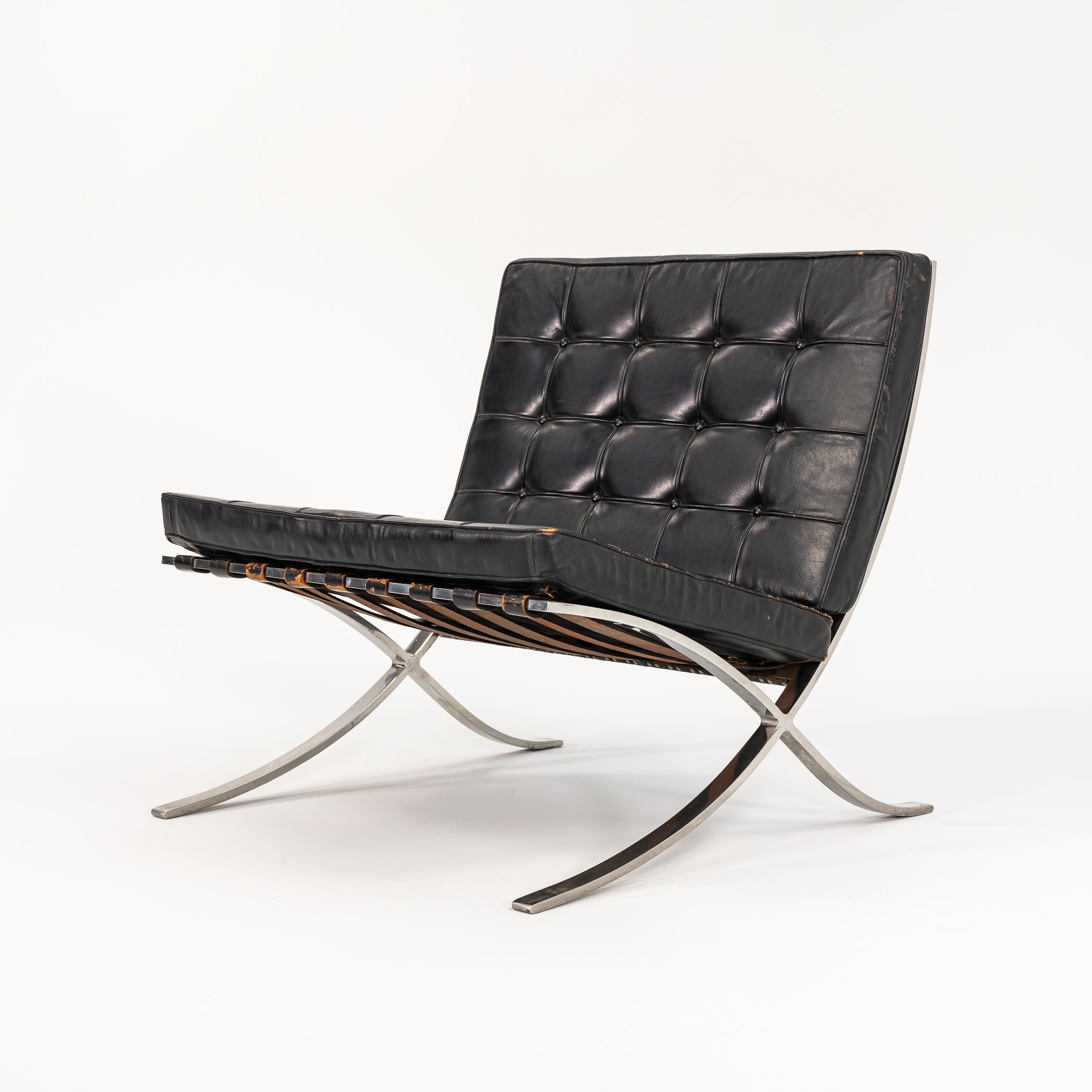


The Barcelona Chair: one of the most important modernist designs
While there is fierce argument over who would be included in a 20th century modern furniture “Mount Rushmore” if it existed, it’s undeniable that the Barcelona Chair would be on there. (We also think that the Eames Lounge Chair and Eero Saarinen’s Womb Chair would also be included, but that’s just us.)
The Barcelona Chair has become an icon of modern design, and, as a timeless classic, it has become a coveted collector’s item.


Mies van der Rohe's vision and Florence Knoll's production-savvy
This iconic chair was designed by one of the most influential architects of the 20th century, Ludwig Mies van der Rohe.
Mies was deeply engrained in the Bauhaus School, and the Barcelona Chair is (at least in concept) an ideal expression of the Bauhaus philosophy of “form follows function”—the structure’s axis is at the sides of the chair, rather than the front, producing a cantilevered form that allows for a more organic and comfortable experience when sitting in it. While perhaps the intention, I don't find the Barcelona to be in the top tier of comfort.
The Barcelona Chair was originally designed in 1929 as a monument to embody the ideals of the Weimar Republic: democracy, progressivism, prosperity, and pacifism. It was envisioned to be symbolic of the progress of the 20th century and to mark the hope after World War I.
Mies said that “I feel that it must be possible to harmonize the old and new in our civilization,” and he brought that ethos into his process for designing the Barcelona Chair. The scissor-structure dates back to Egypt in the 16th century BC, but Mies updated it to its most slender and simplest essence.
After honing the design through several iterations of prototypes, the Barcelona Chair was produced—and continues to be produced—by Knoll starting in 1947. It was Florence Knoll—Mies’s student, advisee, and friend since their time at IIT—who took his visionary and iconic design and brought it to the wider world.
Want to buy a Barcelona Chair, but not sure what's real and what's fake?
Thanks to the partnership between Mies van der Rohe and Florence Knoll, the Barcelona Chair became one of the most iconic design objects of the 20th century. And, when anything becomes that popular, it’s not surprising that it also becomes one of the most imitated and knocked-off designs as well.
On one hand, well-known designers were so inspired by the Barcelona Chair that they used it as a starting point for their own creative designs—an example of this is Nicos Zographos’ CH28 Ribbon Chair.
On the other hand, there are bad actors passing off fakes as genuine Barcelona Chairs for sale online. There are also manufacturers actively producing copies, which are made to be as close as possible to the originals. In almost all cases, there are tell tale signs of fakes, but this changes year after year and requires careful inspection.
To clamp down on unauthorized replicas, Knoll obtained a federal trade dress protection in 2004 for the “total visual image” of the Barcelona Chair and Ottoman. This protection also recognized Knoll as the producer of “authentic” Barcelona Chairs, and it still manufactures them today, although not as many as it previously had over the past three-quarters of a century.
With a flood of knock-offs, imitations, and fakes on the market, it's hard to know when you’re buying a Barcelona Chair that is and isn’t authentic.
We hope that this can be a comprehensive resource to understand the different iterations of the Barcelona Chair and to help discern between the real deal and the frauds.

Pre-Knoll prototypes (1929–1946)
Any authentic Barcelona Chair produced before Knoll began mass production in 1947 is extremely rare and usually museum-quality.
There were originally only two prototypes with corresponding ottomans built for the Weimar Republic pavilion for the Barcelona Industrial Exposition of 1929—hence the name “Barcelona” for the design. These two chairs had a chrome-plated flat-bar steel construction with ivory-colored pigskin cushions filled with horsehair, and they were intended to be fixed pieces that remained in place only at the Barcelona Pavilion.
The first commercially produced (not mass produced, but produced for consumers to buy) examples were made by hand in Josef Müller’s Berliner Metallgewerbe studio in Berlin in 1930. The distinguishing characteristic on these examples is that, rather than being bolted like the original prototypes, these have a screw connection lap joint at the corners of each element. An example of these chairs is exhibited at The Museum of Fine Arts, Houston (where, coincidentally, Mies created the main plan for the campus and designed several buildings).
In 1931 and 1932, Mies worked with the Bamburg Company to attempt to mass produce the Barcelona Chair and Ottoman. These examples are lap jointed with two screws placed on a diagonal. A 1931 example was sold by Christie’s in 1999 for £56,500. In 1932, the leather straps on the back of the chair were moved to cover the intersecting joints, whereas before it was exposed.
Production was halted during World War II and, after Mies fled Nazi Europe, resumed in New York City, where Treitel-Gratz manufactured them between 1945 and 1947.

Early Knoll iterations (1947–1963)
After being one of the first designers Florence Knoll approached to collaborate when she first started with Knoll Associates, Mies granted Knoll the rights to manufacture the Barcelona Chair and his entire collection furniture. Early Knoll Barcelona Chairs are rare and often somewhat deteriorated depending on the fill material inside.
Along with the upholstery tags, one helpful way to know that a Barcelona Chair is an authentic Knoll example is the thick welted piping on the cushions. This alone does not authenticate the chair, but is a helpful contributing factor.

Gerald R. Griffith (1960–1970)
Throughout the 1960s and early 1970s, Mies van der Rohe worked with Gerald R. Griffith, a metalworker in Chicago, to handmake a small number of Barcelona chairs for his commissioned building projects in the city, including 860-880 Lake Shore Drive Apartments. These examples are also rare and highly collectible, since there were so few made and because of their hand-built craftsmanship.
The Griffith Barcelona Chairs were the first to use stainless steel—Mies admitted at the time that he would have used stainless steel from the beginning rather than chrome-plated steel had the technology been available. They have extremely precise corners and less reinforcement at the central cross than their Knoll contemporaries. If assessing one of these, the corners of the feet are distinctly sharp, not curved like the typical Knoll examples.

Stainless-steel Knoll iterations (1964–early 1990s)
Following Gerry Griffith’s example, Knoll switched their production of Barcelona Chairs from chrome-plated to stainless steel in 1964.
The most collectible examples of Barcelona Chairs from this era are the bronze-plated versions manufactured by Knoll after Mies van der Rohe’s death in 1969. They were only used for special commissions, so they are very rare.

Modern Knoll iterations (mid-1990s–present)
In the mid-1990s, Knoll added Mies’ signature to the back right leg (and underside of the frame for stainless versions), next to “KnollStudio,” on each new Barcelona Chair to prove it’s authentic. This is a very helpful thing to look for, not only to judge if a Barcelona Chair is authentic or not but also to date its production.
During this era, Knoll also returned to a chromed steel frame offered at a lower price, with the hand-polished stainless steel examples still available for a significant premium (nearly twice the cost) due to the handmade nature of the stainless examples and additional time it takes to produce the frames.

How do you know it's an authentic Knoll Barcelona Chair?
So, what can you look for to see if a Barcelona Chair is authentic or a fake?
Throughout every era, the cushions are upholstered with 40 individual panels cut, hand-welted, and hand-tufted from a single hide, so you can count the panels and see if there are obvious signs that the leather came from more than one hide. The seat material should be firm to sit in, rather than overly soft.
There should also always be eight leather straps on the back of the chair, regardless of era—though the placement of the leather straps across the back can be helpful in determining when an early Barcelona Chair was produced.
On every Barcelona Chair produced by Knoll throughout the years, there should be a label on each of the cushions confirming that it was manufactured by Knoll. Sometimes these labels also reveal when the chair was produced. These labels, however, sometimes are pulled off by previous owners. Similarly, there are sometimes paper labels that were stuck onto leather straps or to the frame. These too would regularly fall off over time.
If looking at a vintage example, its likely that the construction is solid stainless steel. Stainless will have a slightly more yellow hue than chrome. It also doesn't stick well to a magnet, so a magnet test is often helpful. If a magnet doesn't stick to the frame, it is likely stainless. Given the premium of cost and labor to make a stainless frame, that is a very likely indicator of authenticity.
Rivets and screws are also important details. Vintage stainless Barcelona chairs by Knoll use screws to secure the scraps to the stainless frame. In more recent chrome-plated examples by Knoll, they instead use rivets to fasten the straps to the frame.
The size of the X weld is also an area worth of paying close attention. We would recommend studying the size and thickness of authentic examples. If you're assessing a Barcelona chair and it has thick welds at the X, run the other way.
If you are interested in owning your own Barcelona Chair but don’t want to navigate the saturated market of fakes and knock-offs, we have several vintage and recent examples of authentic Barcelona Chairs in our curated digital showroom.
Rarify is an evolving collection of iconic, authentic-only furniture by history's most visionary designers. We curate collections of timeless classics and rare, authenticated vintage furniture pieces, as well as the collectible classics of the future.


Share:
In Memoriam: Nicos Zographos (1931–2024), the designer’s designer
In Memoriam: Nicos Zographos (1931–2024), the designer’s designer